Concrete Chasing & Surface Treatment
New or old concrete rarely has a flawless surface: it's left with ridges, high spots, and paint or adhesive residue. Mechanical treatment removes these defects without demolishing the slab — far faster and cheaper than pouring a new floor.
Ol Bud Invest performs the full cycle of concrete treatment. With professional equipment and effective dust extraction, we work fast, clean, and without stopping production in operating facilities.
Three Types of Work
Concrete Milling
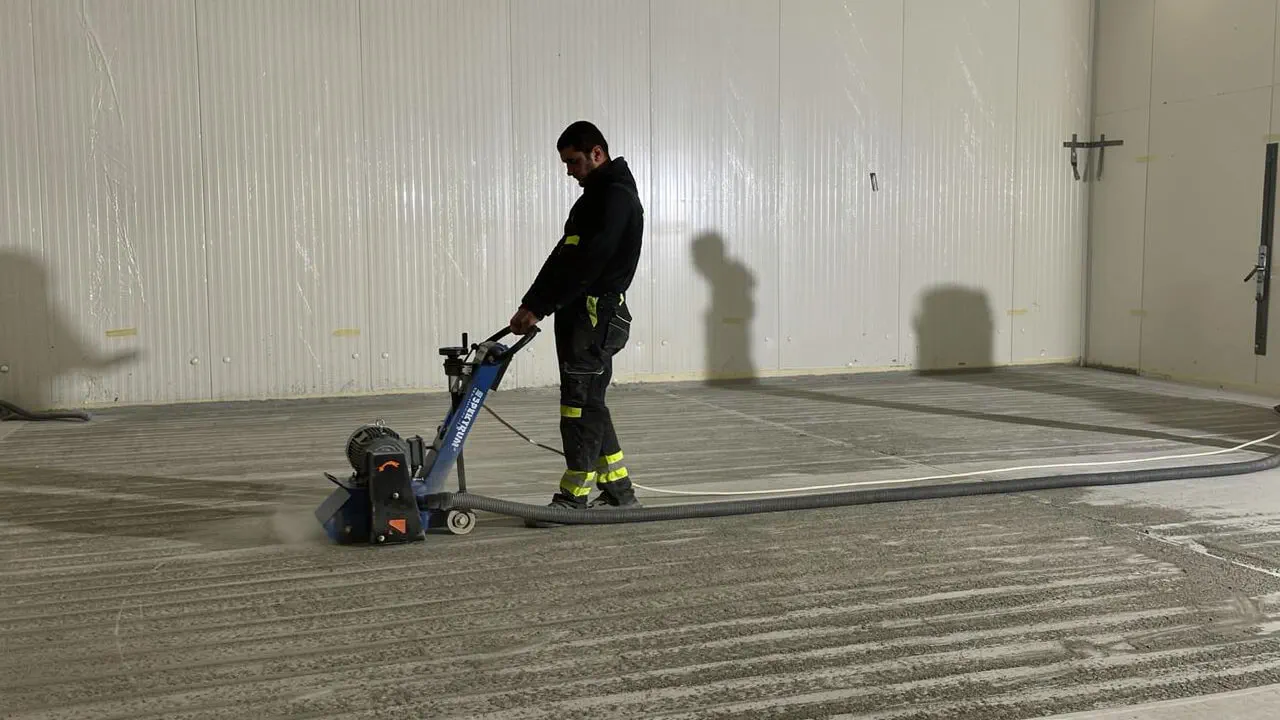
Coarse surface leveling and removal of the defective top layer. We remove significant ridges, old paint or adhesive, preparing a solid base for a new coating.
Concrete Grinding
Finish leveling of the slab and removal of minor flaws. Professional diamond cutters remove level differences, making the floor smooth, strong and dust-free.
Chase Cutting
Cutting channels in concrete for utilities — electrical and plumbing — using a wall chaser with dust extraction. Channels come out clean, and the space stays tidy.
What We Control
- Dust extraction — equipment runs with an industrial dust extractor connected
- Removal and cutting depth — matched to the specific task and utility cross-section
- Work in operating facilities — without stopping production where possible
- Base preparation for topping, self-leveling or polymer coatings
When You Need Mechanical Treatment
Milling is ordered when there's something on the concrete that prevents a new coating from bonding to the base: leftover paint, epoxy or tile adhesive, cement-laitance buildup, local level differences. The miller removes this layer along with the weak top concrete, leaving a rough, "open" surface with good adhesion. Skip this step and any self-leveling or polymer coating risks delaminating.
Grinding solves the opposite problem — making the surface level and smooth. Diamond segments pass over the concrete in several stages with changing grit: first removing high spots and defects, then bringing the surface to the required flatness class. This is how a floor is prepared for thin-film coatings, or how a stand-alone wear-resistant polished concrete floor is produced.
Chasing is cutting channels for concealed utilities. Instead of breaking concrete with a hammer drill — with random cracks and a cloud of dust — a wall chaser with two diamond blades cuts a straight channel of a set depth and width, while a dust extractor captures dust right at the cutting point. A cable or pipe is laid in the channel, which is then plastered flush with the surface.
Mechanical concrete treatment often precedes a finish coating: a level, clean and properly prepared base is what makes a topping, self-leveling or polymer floor last its full design lifespan. We perform this work both as a standalone service and as part of a complete project.
Completed Projects
Sites Where We've Done This
FAQ
Frequently Asked Questions
Milling is coarse layer removal: a drum cutter knocks off high spots, old paint, adhesive and ridges a few millimeters deep. Grinding is a finishing operation: diamond segments level the surface, remove minor defects, and expose the dense aggregate. These operations often run in sequence — first the miller, then the grinder.
We work with a wall chaser and grinders connected to an industrial dust extractor, so most of the dust is captured right at the cutting point. This lets us do the work even in operating facilities with minimal mess.
Yes. In most cases the old floor doesn't need to be demolished — milling removes the worn or contaminated layer, and grinding restores flatness and strength. This is cheaper and faster than pouring a new slab.
Chases (channels) are cut for concealed utility runs: wiring, cables, water-supply and sewage pipes. Channel depth and width are matched to the utility's cross-section, and cutting is done with a wall chaser and dust extractor — no random breaking of walls or floors.
Related Services
Frequently Ordered Together
Free Estimate
We'll Quote Your Job Within 1 Business Day
Free spec sizing for your requirements and a detailed cost estimate.